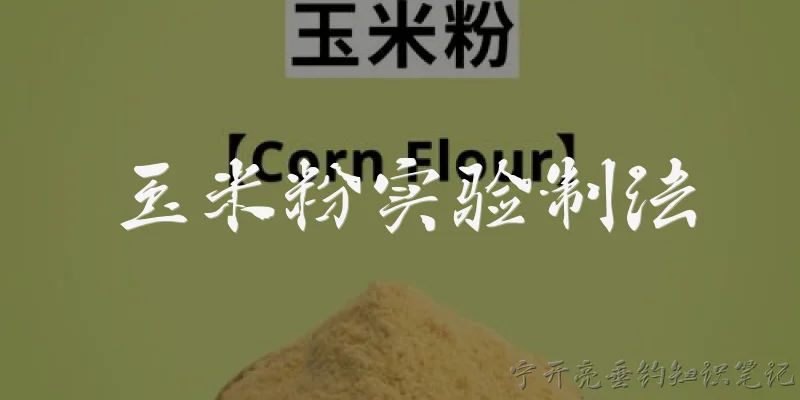
Experimental method for corn flour:What is the experimental method for determining the particle size distribution of corn flour?
Q: What is the experimental method for determining the particle size distribution of corn flour?
A: The particle size distribution of corn flour is typically determined using laser diffraction or sieve analysis. For laser diffraction, a representative sample of corn flour is dispersed in air or water and passed through a laser beam. The scattering pattern is measured and converted to particle size distribution using Mie theory. For sieve analysis, a series of standard sieves with decreasing mesh sizes are used. A known weight of corn flour is placed on the top sieve and shaken mechanically for a set time. The mass retained on each sieve is recorded, and the percentage passing or retained is calculated. Both methods provide critical data for assessing flour texture, which influences processing and end-use quality. The choice depends on the required size range and precision.
Q: How can the moisture content of corn flour be measured experimentally?
A: The moisture content of corn flour is commonly measured using the oven-drying method. A pre-weighed sample of corn flour (about 2-5 g) is placed in a moisture dish and dried in a forced-air oven at 105°C until constant weight. The weight loss is calculated as a percentage of the original sample weight. Alternatively, rapid methods such as infrared moisture analyzers or Karl Fischer titration can be used. Infrared analyzers heat the sample with a halogen lamp and measure weight loss continuously, providing results in minutes. Karl Fischer titration is more precise for low moisture levels but requires specialized reagents. The oven method is the reference standard due to its accuracy and simplicity. Moisture content affects flour stability, shelf life, and processing behavior.
Q: What experimental procedure is used to evaluate the pasting properties of corn flour?
A: The pasting properties of corn flour are evaluated using a Rapid Visco Analyzer (RVA) or a Brabender Viscoamylograph. In the RVA method, a slurry of corn flour (typically 8-12% solids, w/w) is prepared in distilled water. The slurry is subjected to a controlled heating and cooling cycle: heating from 50°C to 95°C at a constant rate, holding at 95°C for a set time, then cooling to 50°C. The viscosity is continuously recorded, yielding parameters such as peak viscosity, trough, breakdown, final viscosity, and setback. These parameters indicate the flour's thickening ability, shear stability, and retrogradation tendency. The RVA is widely used because it requires small samples, short test times, and provides reproducible results. The data are essential for predicting the performance of corn flour in food products like sauces and baked goods.
Q: How is the water absorption capacity of corn flour determined experimentally?
A: The water absorption capacity (WAC) of corn flour is determined by mixing a known weight of flour with excess distilled water, allowing it to equilibrate, and then separating the unabsorbed water by centrifugation. A typical procedure: 1 g of corn flour is mixed with 10 mL of water in a centrifuge tube, vortexed, and left at room temperature for 30 minutes. The mixture is then centrifuged at 3000 rpm for 15 minutes. The supernatant is discarded, and the wet sediment is weighed. WAC is expressed as grams of water absorbed per gram of flour. Alternatively, the supernatant volume can be measured. Factors such as particle size, starch damage, and protein content influence WAC. This method is simple and widely used to assess the flour's ability to retain water, which affects dough consistency and product texture.
Dialogue about
Common scenarios of "Experimental method for corn flour"
【Student】 Professor, I'm having trouble getting consistent results with my corn flour experiments. Do you have any advice?
【Professor】 Consistency starts with the raw material. Are you using the same variety of corn and the same milling method each time?
【Student】 I've been using yellow dent corn from the same supplier, but I switch between a blade grinder and a burr mill depending on availability.
【Professor】 That could be a major source of variability. Different mills produce different particle size distributions, which affect hydration and reaction rates. You should standardize your milling method.
【Student】 I see. So if I stick to a burr mill and sieve to a specific particle size range, that would help?
【Professor】 Exactly. Sieve to a narrow range, like 250-300 microns, and record that. Also, control the moisture content of the flour before each experiment.
【Student】 How do I control moisture content? I usually just store it in a plastic bag.
【Professor】 You can equilibrate the flour in a desiccator over a saturated salt solution to achieve a known relative humidity. For example, saturated sodium chloride gives about 75% RH.
【Student】 That sounds doable. What about the experimental conditions? I'm testing enzymatic hydrolysis of corn flour.
【Professor】 For enzymatic assays, you must control temperature, pH, and ionic strength precisely. Use a water bath with a shaking incubator to maintain constant temperature and mixing.
【Student】 I've been using a static water bath and stirring occasionally. Is that a problem?
【Professor】 Yes, inadequate mixing can lead to concentration gradients and inconsistent reaction rates. A shaking incubator or overhead stirrer is better.
【Student】 Okay, I'll switch to a shaking incubator. What about the enzyme concentration? I usually just add a fixed volume of enzyme solution.
【Professor】 You need to determine the protein concentration of your enzyme preparation and add a known amount of activity units per gram of flour. That way, you can compare across experiments.
【Student】 I'll need to run a Bradford assay or something similar. Any other tips for reproducibility?
【Professor】 Always run triplicate samples and include a blank without enzyme. Also, calibrate your pH meter and balance regularly. Small errors can accumulate.
【Student】 I'll do that. Should I also standardize the way I stop the reaction? I've been using heat inactivation, but sometimes I see continued activity.
【Professor】 Heat inactivation can be inconsistent if the temperature isn't reached uniformly. Consider using a chemical stop like trichloroacetic acid or adjusting pH to denature the enzyme.
【Student】 I'll test both methods. Finally, how should I analyze the data to ensure statistical significance?
【Professor】 Use appropriate statistical tests, like ANOVA for multiple comparisons, and report confidence intervals. And always document every step so others can replicate your work.